
Shit as System: Thinking with Joanna Macy

by Sarah Nahar


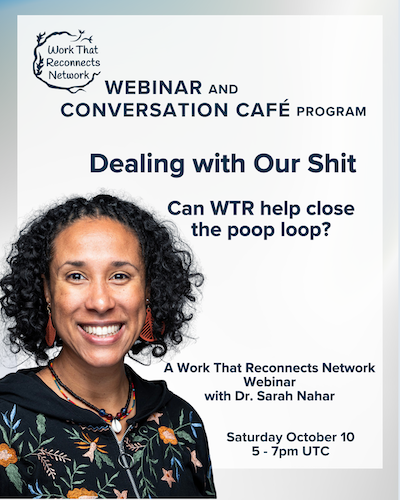
“Shit as System: Thinking with Joanna Macy” is Chapter 5 of the dissertation Fertile, Social, Dangerous, Sacred, Gift, and System: Religion, Salt City Harvest Farm, and the Future of Human Shit written by Dr. Sarah Nahar and completed in April of 2025.

Abstract


Shit, the taboo term for the human excreta that exits the anus, can be understood as sacred. Shitting, the vulgar verb to describe the act of discarding solid excreta, can likewise be understood as religious ritual activity. This counters the Dominant Social Paradigm’s (DSP) in the United States (US) of the placement of shit as profane, and shitting as unceremonial. This dissertation aims to reclaim the word shit from the realm of what the DSP has rendered invisible and unspeakable, and spark rigorous academic discussion about it in the context of Religion and Environmental Studies in the US. 

The DSP is the set of widely held values, practices, and frameworks that shape a society’s worldview and influence its institutions. In the current US, the genealogy of the DSP comes from the Doctrine of Christian Discovery (DoCD), manifesting as the societal hegemony of cisheteronormative white Christian supremacist patriarchy. Never uncontested, but never defeated, this DSP views humans as superior to all other species, seeks to enlarge and protect an extraction-powered economy, sees progress as inherent in human history, and relies on technological solutions to address chronic and acute environmental and social problems. 

In addition to analyzing three deceased scholars whose scholarship is foundational to the academic study of Religion, This dissertation features key offerings of leading scholar-activists living in this era, Robin Wall Kimmerer and Joanna Macy. Kimmerer’s writing on the gift economy and grammar of animacy, and Macy’s on general systems theory and the Work That Reconnects are theorized in light of shit and shitting. The result is an examination of the gift of shit, and the systemic nature of shit.

But first, this dissertation uses the phenomena of shit to examine definitions of the sacred and religious activity in the work of Émile Durkheim, Mary Douglas, and Rudolf Otto. In their theories, a focus on shit exposes gaps or ambiguities in the categories they created. As an essential aspect of human life as material beings, why have shit and shitting been so disregarded in the central literature of Religion? The shit we produce has implications for both us as individuals and for our collective life on planet earth, especially in a time of increasing climate chaos. From awe to disgust to neutrality to quiet curiosity, apprehension of its production and presence is evocative but inexact. 

Why the silence and intricate social conventions that render shit as inaudible and invisible as possible? In areas where freshwater flush toilets are the main excreta infrastructure technology (ExIT), why is there so much resistance to ExIT system transformation, even as water-based sanitation is known to be financially costly as well as to toxify rivers and lakes? Why is addressing the worldwide sanitation crisis one of the most underfunded global initiatives?  How is the treatment of shit, labeled a disposable material, replicated in the treatment of people, when they are labeled disposable? As in, who is being treated like shit by this society? What is happening to them? What possibilities of literal and metaphorical (re)integration are there, for materials and populations designated expendable? How does the word shit function linguistically in US American English, and what’s at stake in its use? 

This literature review is enriched by an ethnography of Salt City Harvest Farm (SCHF), an organization serving refugee farmers in upstate New York (unceded Onondaga land), who are in the process of making a collective decision regarding which excreta infrastructure technology (ExIT) system is ideal to construct at their farm site, in the future. The farm currently has one port-a-potty, which is not a sustainable solution. In anticipation of building a more permanent structure, they are going through a process of discerning between a wide range of ExIT options. These include decisions about the toilet interface (pedestal style or squat style), cleaning materials for the intergluteal cleft (toilet paper and/or water cleanse) as well as collection, processing, and disposal options (water-based or compost-based). This dissertation accompanied the first part of SCHF’s process, which involved participant observation, individual interviews, and facilitated group-discussion.

The choice of ethnographic field study was intentional as refugee farmers are treated like shit by US society, partially because they are ambiguous in citizenship, legal status, racialization, and cultural de/assimilation practices, and cannot be neatly categorized. This parallels shit’s ambiguity. In being both alive and dead, fertilizer and poison, attractive and repulsive, shit also cannot be neatly categorized. This causes great discomfort in the DSP which has come to prominence in its ability to enforce its categorizations and classifications, not in the least upon places perceived as “shithole countries,” from whence refugees come. In examining marginal material, from the context on the margins, by a scholar from and associated with historically marginalized communities, this dissertation makes a unique contribution to the emergent interdisciplinary field of discard studies (through Religion and Environmental Studies). Central to that field are the questions of who and what is discarded, and the systems of wasting and power therein. While only shit is extensively discussed throughout this text–urine, menstrual blood and other bodily excreta are sidelined as is any focus on shitting, the questions of integrative ways to discard as humans, and think about our discard as communities, are central. 

This series of Work That Reconnects Training videos was created by Joanna Macy in 2005. It includes a comprehensive framing of the foundational teachings and spiral of WTR in addition to explanations and demonstrations of many of the core practices that make up this transformational body of group work. It is a great resource for emerging facilitators who want to become more familiar with the practices and learn from Joanna’s brilliant example.


In this bundle of videos you get to hear directly from Joanna and see her in action as a WTR facilitator.

This webinar introduces the  workbook, Mindful Earth Liberation: An Expanded Spiral Guide for the Work That Reconnects. Authors Mutima Imani and Angela Miller-Porter will guide participants through the evolution of the WTR spiral, moving from a purely ecological and psychological framework to one that also includes social justice as a core element.


The Expanded Spiral: New Core Elements

The authors will explain the “why” behind adding three critical dimensions to the traditional spiral. These additions ensure that the work of healing the planet is inseparable from the work of healing human systems.

Self-Awareness: Cultivating a deeper internal clarity and emotional resilience as the foundation for external action with an understanding that social location is central to self-awareness.

Social-Awareness & Systems of Oppression: Understanding how historical and systemic power structures (like racism, colonialism, and classism) shape our relationship with the Earth and each other.

Liberation: Moving beyond “sustainability” toward the active dismantling of oppressive structures to create true freedom for all beings.

Throughout the session and the workbook, three core pillars are woven together—much like the indigenous “Three Sisters” planting method where each plant supports the others:

  • Mindfulness: Presence and intentionality in every step.
  • Sustainability: Living in a way that honors the Earth’s limits.
  • Social Justice: Ensuring equity and dignity are at the heart of the “Great Turning.”

This expanded WTR framework is particularly relevant for activists, facilitators, and educators who want to bridge the gap between environmentalism and social justice.


Guest Presenters

Angela Miller-Porter is a mindfulness-based sustainability educator and WTR facilitator. For twenty years, she has taught sustainability at the community, k-12, and university levels. Angela is a certified meditation teacher, weaving mindfulness into all she does. Her passion is what she calls the “three sisters revolution” of mindfulness, sustainability, and social justice. In her doctoral research on “Mindfulness in Sustainability Education,” she I utilized the Work That Reconnects (WTR) framework to design and teach a university course, Mindfulness & Sustainability. Angela worked with Mutima Imani (the creator of the expanded WTR spiral) to write a guidebook, Mindful Earth Liberation: An Expanded Spiral for the Work That Reconnects, to ensure that the revolution is inclusive with liberation for all. Angela’s business is Awakening Earth Health Coaching.

Queen Rev. Mutima Imani (she/her) has a Masters Degree in Public Administration with an emphasis in Phenomenology. She is an internationally recognized facilitator, speaker, and author specializing in transformative practices that awaken personal and collective potential for a thriving global society. She is the convener of Awaken to Love and a dedicated steward of the Work That Reconnects (WTR).

Mutima brings a decolonized, inclusive lens to themes of justice, equity, diversity, and inclusion (JEDI) in social and environmental activism. Drawing on a wealth of experience as a spiritual leader and healer, Mutima intertwines ancestral wisdom, deep ecology, and community-based practices to address the root causes of oppression, disconnection, and ecological collapse.

Mutima is the author of A Global Invitation to a Thriving Society: The Promise of the Great Turning, a groundbreaking exploration of how Joanna Macy’s WTR spiral can evolve to address the polycrisis of our time. With a focus on healing intergenerational and racial trauma, nurturing resilience, and fostering liberation, she empowers individuals and communities to navigate the transition toward a just, regenerative future.


At the one year mark of Joanna Macy’s passing, we gathered to celebrate the audiobook publication of her memoir, Widening Circles, read by Leilani Navar, host of Turning Season Podcast. In this interactive event, Leilani is interviewed by Jess Serrante, host of the We Are the Great Turning podcast – Joanna’s final project. These two WTR facilitators and friends of Joanna’s share what they learned from Joanna’s life story and invite participants into conversation about how her story can help all of us to rise to meet the opportunities and challenges of our times. Participants reflect together, share what Joanna’s story stirs in them, and bring questions to Leilani and Jess.

The audiobook is now available on all audiobook sales channels including the New Society Publishers website (be sure to select Audiobook format at checkout).


Gratitude Shared during the webinar:

Thanks so much for a beautiful memory honouring Joanna. Great to be in your company


Thank you everyone it was super inspiring to share this moment together, honoring Joanna and life itself 


Thank you for the rich conversation.


About the Presenters

Leilani Wong Navar is a mother, acupuncturist and herbalist, and dreamworker. With groups, she facilitates the Work that Reconnects and teaches practical wisdom from Chinese Medicine. Leilani hosts Turning Season Podcast, a series of conversations with people around the world taking part in the Great Turning in their own unique way.

Leilani attended Evergreen State College where she studied Political Economy and Holistic Health, and earned her Masters of Science in Oriental Medicine from the National University of Natural Medicine. She is in ongoing study and practice of traditional wisdom and modern science about caring for the landscape of the body, and the body of the Earth.

Jess Serrante is a ritualist, cultural regeneration facilitator, and leadership coach who works with people at the intersection of their grief, their love for the world and their hunger to create a more beautiful future together.  For over a decade she has been a practitioner and teacher of the Work That Reconnects — the transformative framework developed by eco-philosopher Joanna Macy — and is the creator and host of the We Are The Great Turning podcast. Her style is warm, grounded, and a little irreverent — she has a gift for helping you fall deeper in love with life, even when — especially when — it’s breaking your heart. She lives in Berkeley, California, where she also tends her beehives. You can find her online at substack.com/@jessserrante.

The midpoint between truth and reconciliation is reparations.

Dr. David Ragland, Co-Founder and Co-ED, The Truth Telling Project; Director, Grassroots Reparations Campaign; Lecturer on Reparations as Spiritual Practice, Harvard University

In settler-colonial nations like Australia, Canada, and the United States, the historical and ongoing ramifications of land theft, slavery, white supremacy, wealth inequity, and harmful government policies mean that reparations are needed. However, national dialogues about reparations can often be fraught with denial and resistance. Too often, reparations are associated with shame and punishment rather than mutual healing and liberation. Frequently, institutional and governmental reparations stall out before they even begin.

Elyshia Holliday and Hilary Giovale have been cultivating a solution to this complex problem over the last six years, by supporting settlers of European descent in designing personal reparations plans and bringing them to life within their families and communities. Their methodology leans into truth-telling about our families’ and nations’ histories, honest self-reflection, and ritualized apology and forgiveness. Elyshia and Hilary have guided hundreds of people through this process. As a result, many have developed a newfound sense of right relations, purpose, and joy.

In this interactive session, Elyshia and Hilary compassionately guide participants to courageously draw on their strengths, interests, and histories to begin developing personal reparations plans that are sustainable for the long-term. Participants are invited to consider personal reparations as a source of purpose, joy, and mutual liberation rather than guilt, shame, and punishment. Everyone who has the capacity to attend webinars also has the capacity to begin this process, one step at a time. Those of European descent may find this session most relevant.

In advance of viewing this recording, we encourage you to orient yourself by viewing the recording of Becoming a Good Relative: Calling White Ancestors to Truth, Healing and Repair. 


Resources (also see resources here)

Reclaiming our Indigenous European Roots, Lyla June

Grounding Practice with Hilary Giovale: Connecting With Ancestral Wisdom

Spell Bowl Prayer (Ahlay Blakely makes ceramic bowls with this spell (and others) inside)

Guide to Making a Personal Reparations Plan

Some US and Canada land tax programs:
American Indian Community House (New York)
Ancestral Homelands Reciprocity Program (Nevada City, California)
Appalachian Rekindling Project (Central Appalachia)
Hō’ahu Kaua’i Land Tax (Kaua’i, Hawai’i)
Honor Native Land Tax (Albuquerque, New Mexico)
Kuuy Nahwá’a (Los Angeles)
Lahaina Community Land Trust (Maui, Hawai’i)
Lenapehoking Land Acknowledgment Honorarium (New Jersey/Delaware/Pennsylvania/New York)
Miami Nation of Indiana Honor Fund (Indiana)
Mni Sota Makoce Honor Tax (Minnesota)
Nii’kinaaganaa Foundation (Canada)
O’ga P’ogeh Land Tax (Santa Fe, New Mexico)
Real Rent Duwamish (Seattle)
Shuumi Land Tax (Bay Area, California)
Wiyot Honor Tax (Northern California)
Wolankeyutomone kisi apaciyewik Fund (Maine)
Yunakin Land Tax (San Francisco)


About the Presenters


Hilary Giovale is a writer, community organizer, facilitator, and white American settler who lives on Indigenous land in Flagstaff, Arizona. As an active reparationist, she seeks to follow Indigenous and Black leadership in support of human rights, environmental justice, and equitable futures. She is the author of the award-winning book Becoming a Good Relative: Calling White Settlers toward Truth, Healing, and Repair, now in its second edition. Learn more about Hilary’s work here: https://www.goodrelative.com/

Elyshia Holliday is the Executive Director of the Organization of Nature Evolutionaries, a Naturopath, community facilitator, and mother committed to restoring the human–Earth relationship. For more than two decades, she co-led work rooted in ecological restoration and ceremonial practice. For the past six years, she has co-facilitated the Rekindling Ancestral Memory Circle, supporting European-descended settlers in recovering Earth-honoring ancestral ways, acknowledging historic harm, and practicing reparations. She lives on the ancestral lands of the Yakama people in Washington state .Learn more about Elyshia’s work here: https://www.natureevolutionaries.com/vision-mission

This episode of the Turning Season podcast includes an excerpt from the audiobook of Widening Circles, the memoir of Joanna Macy. It also includes a telling of how the audiobook project came to fruition from narrator and podcast host, Leilani Navar.

In this excerpt about Joanna’s year in Sri Lanka, you’ll hear how she participated in and studied the Sarvodaya Shramadana Sangamaya movement in 1979, when she was at 50 years old.

Her memoir reads like a novel, and this chapter has so much of what Leilani loves about it – her adventurousness, her passion, the breadth and depth of her thinking, her moments of spiritual insight and awakening, her openness to love and friendship, her lyrical writing, and the chance to learn about another time, place, and response to social and ecological need. Her adventurous, passionate life interwove with major events and ideas of the 20th century – which mattered to her in a deeply personal way.

Joanna Macy was a beloved teacher, mentor, elder, and friend to so many. She was a scholar and an activist whose work continues to touch countless people around the world and help us find clarity, agency, belonging, and love of life in a world in crisis.


Widening Circles by Joanna Macy is now available in audiobook format. This epic memoir of Joanna’s adventurous and inspiring life is narrated by her dear friend, Leilani Wong Navar. In deep love and remembrance at the anniversary of her passing, we are happy to share that it is available on all audiobook sales channels including the New Society Publishers website effective July 1, 2026

June 20, 2026 – In this webinar, WTR Facilitator Member, Zsanna Sebesteny presents her book, Guardians of the Poison Fire and the projects that emerged from writing it. Zsanna joined by Kathleen Rude and Kathleen Sullivan, two experienced Nuclear Guardians who have worked closely with Joanna Macy and her vision of the Nuclear Guardianship ethic. Our explorations take us to a broader consideration of Guardianship Consciousness, as we invite participants, to share about what they protect and what challenges and inspires them.

Read the summary on this page to have an idea of the story in the book and follow the link to download it, if you wish.

Zsanna is a WTR and Active Hope Circle facilitator. She is currently creating a community called Guardians of Gaïa on Patreon, with the intention of honouring and supporting Guardians of all kinds, so that they are nourished and inspired in their projects. Her motto: We are all Guardians of something! What do you protect?


Connecting with the presenters and their work

Zsanna’s work: 

  • Guardians of the Poison Fire by Zsanna Sebesteny is available as a free download in English, Spanish or French
  • Zsanna’s website: Echos de la Terre
  • Zsanna’s Guardians of Gaïa Patreon page – Free membership gives access to interviews with Guardians of all kinds. Paying membership of Guardians of Gaïa supports Phoenix’s work and these projects, and gives access to community calls to support your own Guardianship projects.
  • Guardians of the Poison Fire film trailer in English, French and Spanish


Kathleen Rude’s work:


Kathleen Sullivan’s work: 


Reading Recommendations and Related Resources : 


Gratitude from the chat:

“I have appreciated every single word and moment so far. This is a profoundly important event, and I admire each of you for your hearts and care and attention and intelligence, and intention to help us all awaken more fully all of the time.”

“Loved the three main speakers, so well informed, committed and truly showing up”

“It was so great to see the trio and hear your thoughts on nuclear guardianships!!!”

“Very inspiring and encouraging to be in community here”

“Loved the warmth! A welcome shift from what I find in the world these days.”


About the Presenters

Zsanna Bird River is a Work That Reconnects facilitator living in southern France and Spain who guides the non-profit association Echos de la Terre. Inspired by rituals emerging from Joanna Macy’s work, Zsanna tells a story that came as a memory from the future: “Guardians of the Poison Fire”. She now plans to make the film of this story and to continue developing the community “Guardians of Gaïa” on Patreon, which honours guardians of all kinds that take care of Gaïa.

Kathleen Sullivan, PhD is the Co-Chair of the Nuclear Truth Project an international initiative connecting Indigenous and First Nations Peoples, affected community members, civil society organizations, experts and governments working for nuclear abolition, and director of Hibakusha Stories (an ICAN partner, Nobel Peace Prize 2017). Kathleen has supported the facilitation of hibakusha voices in conferences and UN fora on the humanitarian and environmental consequences of nuclear weapons. She is the Nuclear Guardian Fellow of the Joanna Macy Center, at Naropa University.

Kathleen Rude is a longtime Work That Reconnects facilitator and mentor, an author, healer and anti-nuclear activist. She is a Network Weaver and was mentored by Joanna Macy. Joanna opened her eyes to the perils of nuclear weapons and power and Kathleen has been advocating for a nuclear-free world ever since. To help people engage with the Spiral outside of workshops, she created a Guided Self-Practice of the WTR, a 42-minute interactive audio recording. Kathleen fell in love with the natural world as a young child and found her voice for environmental activism at age 10. With degrees in wildlife ecology and environmental policy, Kathleen worked as an environmental writer for 15 years. Her apprenticeships with North American indigenous elders inspire her healing practice and ceremonial work. Her website is GaiaWisdom.org.


About the WTR Network Webinar Program

The Work That Reconnects Network offers a wide range of rich, educational and supportive opportunities for our global community to inform, inspire and keep us connected and resilient within a global community of seekers and activists. Offerings include Spiral events led by WTR facilitators, and a wide variety of sessions with guest teachers from complementary fields. See upcoming offerings and access a treasure trove of past webinars and resources here.


June 6, 2026 – In this webinar, Constance Washburn and Rochelle Calvert invite participants into a journey of engaging our bodies, awakening our nervous systems and accessing the aliveness behind our survival stories. Together, we explore somatic healing WITH nature to support the individual and community as well as introduce ways to weave these practices into the deep and profound work of the Work That Reconnects. We learn how nature is a healing container, an ally and part of who we are as the web of life that can support the transformation and healing of trauma. Building on the practices of mindfulness and Somatic Experiencing with nature, we learn how to become present to the stored traumas stuck within the body, connect to the inherent potential to heal and learn to release unhealthy patterns of trauma to experience ourselves as fully alive. We explore how the WTR spiral journey is a parallel movement sequence to the steps and processes that support somatic healing of trauma for the individual and the community. Participants are invited to consider how continued healing processes can suggest ways to integrate these teachings and practices into their own work as facilitators.

Presenters

Constance Washburn MA is a facilitator and trainer of the Work that Reconnects. She is Co-Director of the Spiral Journey facilitator development program and Founding Weaver of the Work That Reconnects Network. She studied with Joanna Macy starting in 1994. She started Buddhist Practice in 1967 and is a Community Dharma leader in the Vajrayana Tradition. She is a guide of the Community Resilience Model of the Trauma Resources Institute. She has over 50 years of experience designing and directing education and outreach programs. She brings her nature connection, mindfulness and trauma training, theater and education backgrounds together to create opportunities for people to reawaken to their interconnectedness to each other, the earth and to that which is greater than ourselves. www.constancewashburn.com

Rochelle Calvert, PhD, CMT, SEP licensed clinical ecopsychologist, mindfulness teacher, somatic experiencing practitioner has a devoted love to share the power and healing potential of mindfulness, somatic awareness and nature. She has studied and taught mindfulness and somatic healing for the past 23 years and knows personally the transformational potential. To share the love of these healing practices she has published a book Healing with Nature: Mindfulness and Somatic Practices to Heal from Trauma. Dr. Calvert leads courses and retreats in mindfulness, somatic experiencing and Awake in the Wild, nature-based mindfulness. She also facilitates professional trainings for clinicians and travels the country teaching retreats and seminars. She is the director of the Ecotherapy Program at SouthWestern College and New Earth Institute in Santa Fe, New Mexico. She is a certified mindfulness teacher with the Mindfulness Teaching Institute, the International Mindfulness Teachers Association and Awake In The Wild organization. Rochelle now lives in Taos, New Mexico and has a private practice in both Taos New Mexico and San Diego, California.

Resources

Rochelle’s website
Constance’s website

Presentation slides
Upcoming offerings
Moving Between the Worlds a Work That Reconnects Retreat
Healing with Nature- Trauma Care Practitioner Training Program

About the WTR Network Webinar Program

The Work That Reconnects Network offers a wide range of rich, educational and supportive opportunities for our global community to inform, inspire and keep us connected and resilient within a global community of seekers and activists. Offerings include Spiral events led by WTR facilitators, and a wide variety of sessions with guest teachers from complementary fields. See upcoming offerings and access a treasure trove of past webinars and resources here.

May 24, 2026 – What does it look like when the Work That Reconnects takes root in a forest community in the Philippines, or in the high valleys of Pakistan, or among activists in a Colombian city? Join us for a live panel conversation with the inaugural recipients of the Emergence Fund — a micro-grant program launched by the Social Justice Committee of the Work That Reconnects Network to support facilitators in under-represented regions worldwide.

The Emergence Fund was created to break down the barriers — financial, geographic, and institutional — that prevent emerging facilitators from bringing WTR to life in their communities. In this first round, four remarkable facilitators received grants to lead locally grounded, culturally rooted projects: Althea Serad is training Indigenous youth leaders in the Sierra Madre forests of the Philippines; Eva Montaña Silva is guiding frontline activists and community members through the Spiral in Manizales, Colombia; Goonja Shrestha is offering women from marginalized communities a Deep Ecology journey rooted in storytelling and art in Kathmandu, Nepal; and Muqadsa Zaineb is creating a sanctuary for young Kalashi women to reclaim their roles as guardians of the land in Pakistan’s Kalash Valleys.

In this live panel, these four facilitators share their experiences, insights, and stories from the field — what they learned, what surprised them, and what the Work That Reconnects looks like when it is adapted with deep care for place, culture, and community. Watch the recording and be inspired by the creativity and courage emerging at the edges of our global network.


Panelists

Althea Serad (Philippines)

In the forest communities of Sierra Madre, Althea is working with collaborator, Steve Manzano, to train Indigenous youth leaders from UGBON to become facilitators of a deeply localized Work That Reconnects practice. Through a hybrid Spiral Journey spanning three months, young leaders will explore Filipino Indigenous worldviews, tend to ecological grief, engage in land-based practices, and master WTR methodology. The result will be a co-created, culturally rooted WTR module that these youth can carry forward, equipped with trauma-informed facilitation skills and the confidence to lead community circles that protect forests, honour cultural continuity, and strengthen Indigenous youth leadership across the region. Learn more about Althea.

Eva Montaña Silva (Colombia)

In Manizales, Eva is bringing the Work That Reconnects directly to those on the front-lines of ecological and social struggle. Through a series of 3–4 gatherings, she’ll guide residents through the full Spiral, with one session specifically designed for activists facing conflict with city authorities. These circles offer a safe container to process fear, frustration, and grief while rebuilding collective resilience and imagination. By making WTR inclusive, and visible in the city, Eva is strengthening community networks, reducing isolation among change-makers, and planting seeds for new collaborations rooted in courage and connection. Learn more about Eva.

Goonja Shrestha (Nepal)

In Kathmandu, Goonja is offering women from marginalized and Indigenous communities a rare gift: a one-day Deep Ecology journey that weaves together storytelling, meditation, and art. This farm-based retreat outside the city creates space for participants to rebuild their relationship with nature, themselves, and each other. With careful attention to cultural grounding, trauma-informed practice, and accessibility, Goonja is designing an experience that honors both individual healing and collective belonging. The project includes three months of thoughtful preparation and post-retreat reflection, ensuring the work deepens with each iteration and creates lasting shifts in how participants care for the Earth and their communities. Learn more about Goonja.

Muqadsa Zaineb (Pakistan)

In the Kalash Valleys, Muqadsa is creating a sanctuary for young Indigenous women to reclaim their role as guardians of the land. Over three months, 15–20 women and girls will gather weekly at the Basali House for circles that blend traditional ecological knowledge with modern tools like land mapping and climate-safe farming practices. This project nurtures leadership, builds confidence, and ensures young Kalashi women have a voice in local climate and land-use decisions. By creating learning materials in the Kalasha language and establishing the Basali House as a community hub, Muqadsa is planting seeds for intergenerational wisdom-sharing and environmental stewardship that will ripple through the valleys for years to come. Learn more about Muqadsa.

Steve Manzano (Philippines)

In the forest communities of Sierra Madre, Steve is working with collaborator and WTR Network Facilitator Member, Althea Serad, to train Indigenous youth leaders from UGBON to become facilitators of a deeply localized Work That Reconnects practice. Through a hybrid Spiral Journey spanning three months, young leaders will explore Filipino Indigenous worldviews, tend to ecological grief, engage in land-based practices, and master WTR methodology. The result will be a co-created, culturally rooted WTR module that these youth can carry forward, equipped with trauma-informed facilitation skills and the confidence to lead community circles that protect forests, honour cultural continuity, and strengthen Indigenous youth leadership across the region.