
Shit as System: Thinking with Joanna Macy

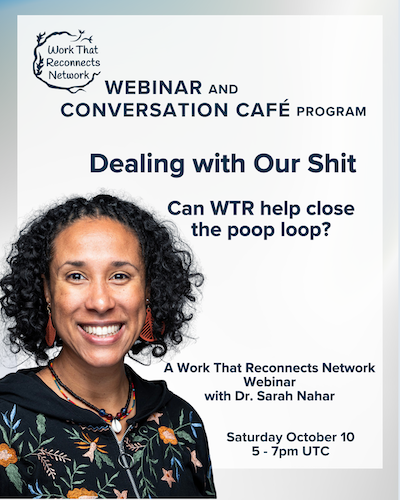
by Sarah Nahar


“Shit as System: Thinking with Joanna Macy” is Chapter 5 of the dissertation Fertile, Social, Dangerous, Sacred, Gift, and System: Religion, Salt City Harvest Farm, and the Future of Human Shit written by Dr. Sarah Nahar and completed in April of 2025.

Abstract


Shit, the taboo term for the human excreta that exits the anus, can be understood as sacred. Shitting, the vulgar verb to describe the act of discarding solid excreta, can likewise be understood as religious ritual activity. This counters the Dominant Social Paradigm’s (DSP) in the United States (US) of the placement of shit as profane, and shitting as unceremonial. This dissertation aims to reclaim the word shit from the realm of what the DSP has rendered invisible and unspeakable, and spark rigorous academic discussion about it in the context of Religion and Environmental Studies in the US. 

The DSP is the set of widely held values, practices, and frameworks that shape a society’s worldview and influence its institutions. In the current US, the genealogy of the DSP comes from the Doctrine of Christian Discovery (DoCD), manifesting as the societal hegemony of cisheteronormative white Christian supremacist patriarchy. Never uncontested, but never defeated, this DSP views humans as superior to all other species, seeks to enlarge and protect an extraction-powered economy, sees progress as inherent in human history, and relies on technological solutions to address chronic and acute environmental and social problems. 

In addition to analyzing three deceased scholars whose scholarship is foundational to the academic study of Religion, This dissertation features key offerings of leading scholar-activists living in this era, Robin Wall Kimmerer and Joanna Macy. Kimmerer’s writing on the gift economy and grammar of animacy, and Macy’s on general systems theory and the Work That Reconnects are theorized in light of shit and shitting. The result is an examination of the gift of shit, and the systemic nature of shit.

But first, this dissertation uses the phenomena of shit to examine definitions of the sacred and religious activity in the work of Émile Durkheim, Mary Douglas, and Rudolf Otto. In their theories, a focus on shit exposes gaps or ambiguities in the categories they created. As an essential aspect of human life as material beings, why have shit and shitting been so disregarded in the central literature of Religion? The shit we produce has implications for both us as individuals and for our collective life on planet earth, especially in a time of increasing climate chaos. From awe to disgust to neutrality to quiet curiosity, apprehension of its production and presence is evocative but inexact. 

Why the silence and intricate social conventions that render shit as inaudible and invisible as possible? In areas where freshwater flush toilets are the main excreta infrastructure technology (ExIT), why is there so much resistance to ExIT system transformation, even as water-based sanitation is known to be financially costly as well as to toxify rivers and lakes? Why is addressing the worldwide sanitation crisis one of the most underfunded global initiatives?  How is the treatment of shit, labeled a disposable material, replicated in the treatment of people, when they are labeled disposable? As in, who is being treated like shit by this society? What is happening to them? What possibilities of literal and metaphorical (re)integration are there, for materials and populations designated expendable? How does the word shit function linguistically in US American English, and what’s at stake in its use? 

This literature review is enriched by an ethnography of Salt City Harvest Farm (SCHF), an organization serving refugee farmers in upstate New York (unceded Onondaga land), who are in the process of making a collective decision regarding which excreta infrastructure technology (ExIT) system is ideal to construct at their farm site, in the future. The farm currently has one port-a-potty, which is not a sustainable solution. In anticipation of building a more permanent structure, they are going through a process of discerning between a wide range of ExIT options. These include decisions about the toilet interface (pedestal style or squat style), cleaning materials for the intergluteal cleft (toilet paper and/or water cleanse) as well as collection, processing, and disposal options (water-based or compost-based). This dissertation accompanied the first part of SCHF’s process, which involved participant observation, individual interviews, and facilitated group-discussion.

The choice of ethnographic field study was intentional as refugee farmers are treated like shit by US society, partially because they are ambiguous in citizenship, legal status, racialization, and cultural de/assimilation practices, and cannot be neatly categorized. This parallels shit’s ambiguity. In being both alive and dead, fertilizer and poison, attractive and repulsive, shit also cannot be neatly categorized. This causes great discomfort in the DSP which has come to prominence in its ability to enforce its categorizations and classifications, not in the least upon places perceived as “shithole countries,” from whence refugees come. In examining marginal material, from the context on the margins, by a scholar from and associated with historically marginalized communities, this dissertation makes a unique contribution to the emergent interdisciplinary field of discard studies (through Religion and Environmental Studies). Central to that field are the questions of who and what is discarded, and the systems of wasting and power therein. While only shit is extensively discussed throughout this text–urine, menstrual blood and other bodily excreta are sidelined as is any focus on shitting, the questions of integrative ways to discard as humans, and think about our discard as communities, are central. 

Transformative EcoSocial Education for the Great Turning

By Maureen Jack-LaCroix

Thesis submitted in partial fulfillment of the requirements for the degree of Doctor of Philosophy in the Curriculum Design & Implementation Program Faculty of Education of Simon Fraser University


Abstract

How do we shift worldviews in The Great Turning, out of the colonial mindset of separation, exploitation and hyper-consumption towards a relational worldview of interdependent people and communities interconnected with the natural world? The purpose of my experiential inquiry is to explore the design and delivery of “Transformative EcoSocial Education” (TESE) that can help that shift happen.

Using Joanna Macy’s Great Turning model for change, the dimensions of EcoSocial Consciousness, Action, and Innovation in education are explored in three Phases. Phase I explores EcoSocial Consciousness, using an eco-feminist methodology that connects research with lived actions to co-develop a community education program. Phase II takes EcoSocial Action using participatory action research to develop and deliver a middle and high school learning resource entitled SLC: Student Leadership for Change. Phase III offers EcoSocial Innovation in the theoretical development of a systemic pedagogical model entitled TESE: Transformative EcoSocial Education which integrates six pedagogies and two transformative learning theories.

My findings from Phase I are that by letting go of the illusion of separation and working collaboratively, one can enable access to the collective intelligence of the field. Further, an educative process of connecting in circles empowers deeper learning and agency in action. Findings from Phase II indicate that ‘how’ ecosocial education is taught is paramount; change happens in the dynamics of relationships; students hold the greatest power for change, and any learning resource needs to foster their evolving consciousness. This entails an inner transformation for the teacher as well as the students. Although the school system provides many barriers, ecosocial educators and students can prevail when they stay connected for greater resilience.

Findings from Phase III lead to the integration of key pedagogical approaches in the TESE model which provide a valuable guideline for optimizing further development of SLC or other ecosocial education programs. The cumulative finding emerging from all three Phases is that developing socio-emotional intelligence in ecosocial education is the most essential ingredient for transforming worldviews from separation to connectedness. This is both the single greatest breakthrough education can evoke and perhaps the most challenging to address in the current school system.

Chaplaining Spiritual Community: Ecodharma in the Anthropocene

by Liz Reynolds


A thesis submitted for graduation from the chaplaincy training program at Upaya Zen Center – Santa Fe, NM, USA


Abstract

As climate catastrophe becomes less theoretical and more the reality of our lived experience, there is a growing need for spiritual support and stewardship as the human species continues to earnestly engage with the difficulty and destruction facing Mother Nature and all sentient beings. This paper explores the growing role of eco-chaplaincy within Buddhist spiritual communities, and by extension the necessity of addressing climate catastrophe as the spiritual emergency that it is. As an increased number of Sanghas are focusing on ecodharma initiatives, nature-based wisdom teachings and ecological advocacy, what kinds of shifts are taking shape within American Buddhism as a result? With Buddhist teachings as frameworks, how can the lessons moving through American Dharma communities reverberate and ripple out into our wider communities as the need for restructuring society at every level becomes more critical? 


Mindfulness in Sustainability Education

by Angela Miller-Porter

A dissertation submitted in partial fulfillment of the requirements for the degree of Doctor of Education at The University of Wisconsin – Stevens Point


Abstract

This study was about a university course, Mindfulness & Sustainability (GC495), that I designed, instructed, and assessed. Twenty-one students and I went on a mindful learning journey; together we cultivated a community of Transformative Sustainability Learning (TSL). I used The Work that Reconnects (WTR) to teach mindfulness in Sustainability Education (SE). This was an exploratory qualitative study that utilized two narrative end of semester questions, one assignment and the Sustainability Mindset Indicator (SMI) pre- post- questionnaire to collect and analyze course impact. The study showed that Sustainability Mindsets were strengthened for students who took GC495.


Embodied Environmental Justice: An analysis of the Work That Reconnects to be used as a valuable resource for embodied social and environmental justice

By Kelsey Eaton

Submitted in partial satisfaction of the requirements for the degree of Master of Science in Community Development in the Office of Graduate Studies of the University of California Davis

Abstract

The Work That Reconnects is a composition of theories and embodied practices designed to support ecological and social healing through in-person and online workshops, retreats, and events. Joanna Macy and her colleagues created the Work That Reconnects in the 1970s in response to increasing concerns about nuclear war. Since its inception, the Work That Reconnects teachings and practices continue to evolve to help people worldwide address the current injustices of our time. The purpose of this study is to analyze the potential of the Work That Reconnects as a valuable resource for embodied environmental justice, defined as an anti- oppression approach to restoring a balanced relationship with ourselves, our community, and the Earth through connection of the mind, body, and spirit to the more-than-human realm. Centered around social and ecological justice and healing, this study on the Work That Reconnects also contributes to the growing research on an anti-oppression approach to support people through planetary crisis. Eleven interviews were conducted online with people connected to the Work That Reconnects to understand how it impacts their lives and engagement in embodied environmental and social justice. These interviews helped answer the following questions: What attracts people to the Work That Reconnects? What contributes to feeling connected to the Work That Reconnects?, What contributes to feeling disconnected to the Work That Reconnects?, How can the Work That Reconnects be helpful for Embodied Environmental Justice?, and How can the Work That Reconnects be more inclusive?. Findings confirm that Work That Reconnects is a transformative tool for restoring balance with self and Earth. However, it still lacks the centering of social justice to support healing at the community level. Recommendations include increased skillful facilitation and deeper commitments to anti-oppression, restorative justice, and amplification of people of the global majority in WTR.

Widening Circles of Care: Exploring Self-Care with Activists Using Ecological Drama Therapy for Masters program in Creative Arts Therapies at Concordia University

By Rebekah Hart

Thesis for Masters program in Creative Arts Therapies at Concordia University

Abstract

Research shows that activists as a population may be at high risk for developing symptoms of trauma, isolation, alienation and burnout due to a host of internal and external factors. This instrumental case study describes a ten-week intervention with a group of female activists exploring the theme of self-care. The interventions were based on the integration of two frameworks: drama therapy methods and processes, and a form of socio-ecological group work known as the Work that Reconnects. Interventions are described and analyzed in terms of the integration of methods and the development of self-care as a guiding theme. The study draws larger implications for activist self-care practice, including the role of honouring painful feelings as integral to self-care, and the potential of using drama therapy to foster collective practices of self-care within activist movements. The study suggests that drama therapists may have a special role to play in supporting activists to find tools to engage sustainably in their work. By integrating the Work that Reconnects and drama therapy methods, this research proposes an ecological drama therapy: a drama therapy practice that is rooted in the perception of our fundamental relatedness with, and responsibility to, all peoples and forms of life.

El impacto percibido de ‘El Trabajo que Reconecta’

Por Felipe Landaeta Farizo y Rocío Cerda


El Resumen

El TQR es un método desarrollado durante los años 70’s y está basado en la obra de Joanna  Macy. A pesar de que Joanna Macy es un referente en el campo de la ecopsicología, este es  el primer estudio acerca del impacto de el TQR. Este estudio cualitativo utilizó el Análisis  Fenomenológico Interpretativo (AFI) para explorar los significados personales de los  participantes y luego interpretar estos resultados. Los resultados revelaron 5 temas  principales: (a) cualidades de la vivencia durante el TQR; (b) impacto a nivel psicológico y  emocional del TQR; (c) cambios conductuales posteriores; (d) influencia de las  expectativas personales; y (e) influencia del contexto del retiro. Los resultados dan cuenta  de algunos aspectos nucleares tanto de la propuesta de Joanna Macy como de la  ecopsicología. Se sugiere profundizar en el estudio del impacto de el TQR, especialmente  en relación al potencial transformador de los rituales y los estados de consciencia que estos  pueden promover durante el TQR. 

La forma de recoger información experiencial, profunda y vívida fue a través de entrevistas  semi-estructuradas, las que buscaban indagar en 3 momentos de tiempo: (a) el período  previo al TQR para explorar las razones para participar; (b) las experiencias y vivencias  durante el retiro; y (c) los efectos percibidos posteriores.


What is the perceived impact of the intensive of The WTR? 

By Felipe Landaeta Farizo y Rocío Cerda


Abstract 

The WTR is a method developed during the 70’s and is based on the work of Joanna Macy. Although Joanna Macy is a benchmark in the field of ecopsychology, this is the first study about the impact of WTR. This qualitative study used Interpretative Phenomenological Analysis (IPA) to explore the personal meanings of the participants and then interpret these results. The results revealed 5 main themes: (a) qualities of the experience during the WTR; (b) psychological and emotional impact of the WTR; (c) subsequent behavioral changes; (d) influence of personal expectations; and (e) influence of the retreat context. The results account for some core aspects of both Joanna Macy’s proposal and ecopsychology. It is suggested to deepen the study of the impact of WTR, especially in relation to the transformative potential of rituals and the states of consciousness that these can promote during WTR. 

The way to collect experiential, deep and vivid information was through interviews  semi-structured, those that sought to investigate in 3 moments of time: (a) the period  prior to WTR to explore reasons for participating; (b) experiences during the retreat; and (c) the subsequent perceived effects. 


What Benefits do Men Experience through the Work That Reconnects? A Phenomenological Inquiry

By Vincent Brown

Dissertation for PhD program in Transformative Studies with a focus in Consciousness Studies at California Institute of Integral Studies (CIIS)

Abstract

This dissertation is a phenomenological inquiry into the lived life benefits of a significantly homogenous group of white men who participated in men-only retreats in the Work That Reconnects that is rooted in the work of Joanna Macy. Their homogeneity is relative age, ethnic heritage, economic status, and access to resources. In this inquiry I use the lenses of tradition, safety, community, environment, and spirituality to explore the impact of the Work That Reconnects. A goal of this inquiry is to understand what benefits these men have experienced through their engagement in these retreats. A secondary goal is to gain insight into what keeps men from attending these retreats as well as what motivates some men to become involved in personal growth activities that lead to social change. The Work That Reconnects is described as an integral dialogic group model that helps men overcome emotional numbness, alexithymia, thus helping them identify and give voice to their inner world of thoughts, feelings, emotions, and core values. I frame this discussion around patriarchy, social masculine norms of behavior, men’s health, aspects of the men’s movement, white privilege, deep ecology, and how self-introspection informs multiple intelligences leading toward an integrum of inclusion. Also included in this discussion is complex systems thinking, the expansion of conscious awareness, neurophysiology, and how brain plasticity v allows neurological change. In addition to the benefits of the Work That Reconnects, I offer a discussion on contradictions and concerns offered as suggestions for growth in this work. I conclude the discussion with a summary of the benefits as expressed by study participants, areas of future research, and recommendations for using the Work That Reconnects with men working to create more meaning, purpose, and value in their lives thereby benefiting themselves, their relationships, and society at large.

Widening Circles of Care: Exploring Self-Care with Activists Using Ecological Drama Therapy for Masters program in Creative Arts Therapies at Concordia University

By Rebekah Hart

Thesis for Masters program in Creative Arts Therapies at Concordia University

Abstract

Research shows that activists as a population may be at high risk for developing symptoms of trauma, isolation, alienation and burnout due to a host of internal and external factors. This instrumental case study describes a ten-week intervention with a group of female activists exploring the theme of self-care. The interventions were based on the integration of two frameworks: drama therapy methods and processes, and a form of socio-ecological group work known as the Work that Reconnects. Interventions are described and analyzed in terms of the integration of methods and the development of self-care as a guiding theme. The study draws larger implications for activist self-care practice, including the role of honouring painful feelings as integral to self-care, and the potential of using drama therapy to foster collective practices of self-care within activist movements. The study suggests that drama therapists may have a special role to play in supporting activists to find tools to engage sustainably in their work. By integrating the Work that Reconnects and drama therapy methods, this research proposes an ecological drama therapy: a drama therapy practice that is rooted in the perception of our fundamental relatedness with, and responsibility to, all peoples and forms of life.

Emotional Methodologies for Climate Change Engagement: towards an understanding of emotion in Civil Society Organisation (CSO)-public engagements in the UK

By Jo Hamilton

Thesis submitted for a Doctor of Philosophy degree in the Department of Geography and Environmental Science, School of Archaeology, Geography and Environmental Science at the University of Reading


Abstract

The inner dimensions of human responses to climate change are complex. They include our cognitive, emotional and affective responses to scientific projections, implications, climate [in]justice, loss of cultures, ecologies and societal collapse. The urgency of action for climate change mitigation and adaptation, combined with the insufficient political responses, contributes to emotions such as grief, fear, despair, and guilt, amongst others. When unexpressed, these emotions can contribute to emotional paralysis and systems of socially organised denial, which can inhibit engagement and action on climate change at individual and societal scales. There is a research gap of methods and processes where emotions relating to climate change can be acknowledged and explored.

A range of methods exist to acknowledge, explore and encourage the processing of the emotions relating to climate change. I collectively term these methods ‘Emotional Methodologies’ (EMs). Varying in intensity, timescale and accessibility, EMs are positioned at the interface of psychological and social approaches to climate change engagement.

This PhD research maps out a range of EMs used in or by Civil Society Organisations (CSOs) to acknowledge and process the emotions associated with climate change. The thesis explores the impacts of participation in EMs with regard to engaging and sustaining engagement with climate change, through investigating emotional dimensions of climate change, emotional habitus, and emotional reflexivity. The blended research combines emotional geography and psycho-social approaches to explore these impacts from the perspectives of facilitators and participants of EMs.

This research evidences the importance of emotionally reflexive practices to enable broader, deeper and more sustained engagements with climate change. Through fostering dimensions of relationship within (to inner, emotional and affectual worlds), between (to other people) and beyond (to the more-than-human world), the EMs created safe-enough spaces to acknowledge painful emotions, and supported the processing of emotions. These EMs helped to cultivate forms of reflexivity which contributed to a ‘deep determination’ and ongoing resource to act for environmental and social justice, and to live the future worth fighting for in the present.