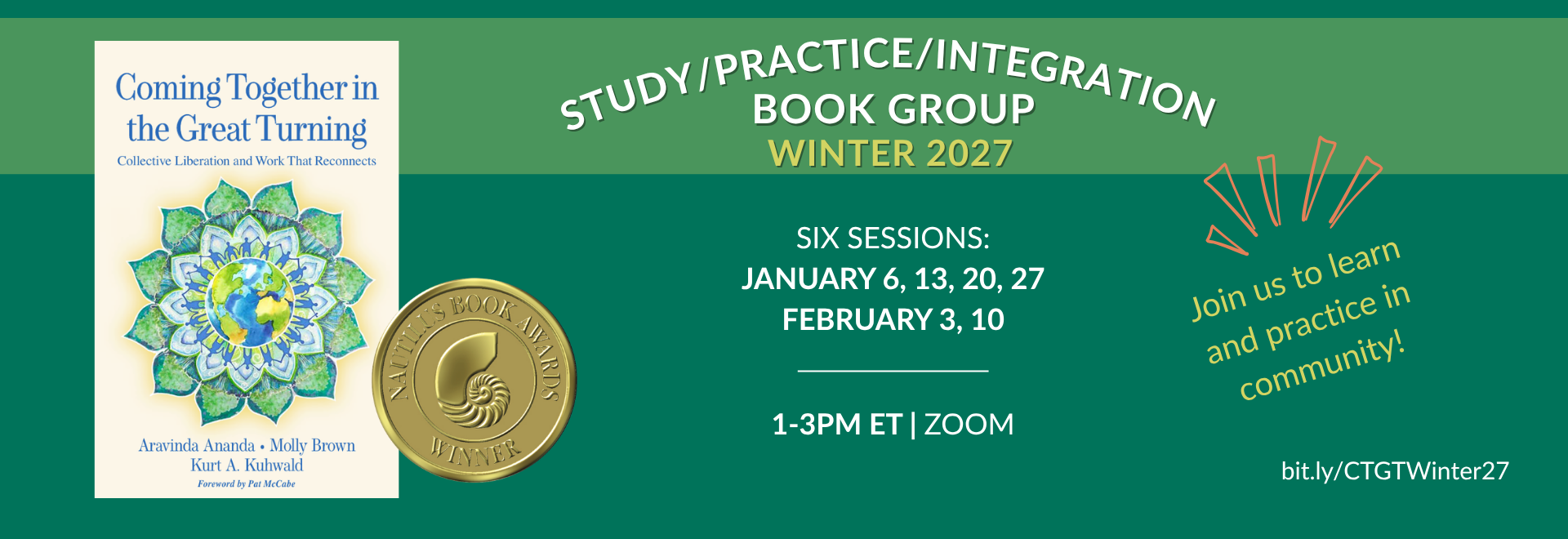
None of us are free until all of us are free—overcoming systemic oppression through transformative group work.

The Work That Reconnects has helped countless individuals to move through denial and despair into meaningful, collaborative action. This essential guide is ideal for those seeking to deepen this work by addressing systemic racism, injustice, and oppression.

Rooted in the deceptively simple premise that none of us are free until all of us are free, Coming Together in the Great Turning represents a decade-long interrogation and expansion of the revolutionary practices of the Work That Reconnects. Powerful contributions from practitioners:

  • Address the false split between environmental and social justice and identify the common roots of human rights abuses and ecological destruction
  • Explore how intersectional systems of oppression manifest in group settings and provide strategies for shifting these dynamics to interconnected systems of support
  • Demonstrate how to move beyond “-isms” and identity politics toward true diversity, equity, inclusion, allyship, solidarity, collective liberation, and a “Just Transition”
  • Share powerful perspectives, teachings, exercises, and rituals drawn from the practical experience of facilitators worldwide
  • Offer specific guidance for creating safer spaces and expanding cultural competency through anti-oppressive and trauma-informed facilitation.

This vital resource is required reading for facilitators and participants, change agents and activists, visionaries, and anyone who feels pain for our world and is committed to catalyzing change for a just and thriving world.

Principles to Foster Collective Connection and Action in Service to Life

These principles were formerly referred to as guidelines for a holonic shift to collective self-interest in chapter 3 of Coming Back to Life by Joanna Macy and Molly Brown; second edition, published 2014. They were originally composed in 1990 by Joanna Macy in collaboration with German colleagues in the Work That Reconnects. This version includes minor adaptations by the WTR Network team.

The Work That Reconnects calls us into personal transformation from isolating self focus into collective connection and purpose. The following 12 principles are offered as guidance to foster this shift in consciousness in ourselves. 

  • Attune to a common intention. Intention is not a goal or plan you can formulate with precision. It is an open-ended aim: may we meet common needs and collaborate in new ways.
  • Welcome diversity. Self-organization of the whole requires differentiation of the parts. Each one’s role in this unfolding journey is unique.
  • Know that only the whole can repair itself. You cannot “fix” the world, but you can take part in its self-healing. Healing wounded relationships within you and between you and others is integral to the healing of our world.
  • You are only a small part of a much larger process, like a nerve cell in a neural net. So learn trust. Trust means taking part and taking risks, when you cannot control, or even see, the outcome.
  • Open to flows of information from the larger system. Do not resist painful information about the condition of your world, but understand that the pain you feel for the world springs from interconnectivity, and your willingness to experience it unblocks feedback that is important to the well-being of the whole.
  • Speak the truth of your experience of this world. If you have persistent responses to present conditions, assume that they are shared by others. Willing to drop old answers and old roles, give voice to the questions that arise in you.
  • Believe no one who claims to have the final answer. Such claims are a sign of ignorance and limited self-interest.
  • Work increasingly in teams or joint projects serving common aims. Build community through shared tasks and rituals.
  • Be generous with your strengths and skills—they are not your private property. They grow from being shared. They include both your knowing and your not-knowing, and the gifts you accept from the ancestors and all beings.
  • Draw forth the strengths of others by your own acknowledgment of them. Never prejudge what a person can contribute, but be ready for surprise and fresh forms of synergy.
  • You do not need to see the results of your work. Your actions have unanticipated and far-reaching effects that are not likely to be visible to you in your lifetime.
  • Putting forth great effort, let there also be serenity in all your doing; for you are held within the web of life, within flows of energy and intelligence far exceeding your own.

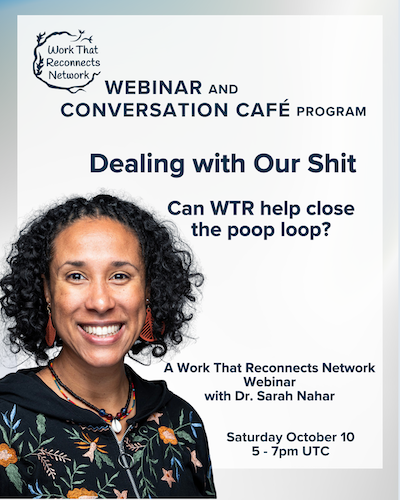
July 23, 2022 – Since Active Hope was first published a decade ago, the Great Unraveling has progressed at an alarming rate. To better address this disturbing new context, Joanna Macy and Chris Johnstone have taken a fresh view of Active Hope, with the tenth anniversary edition published in June 2022. In this webinar, Joanna Macy and Chris Johnstone joined us to share in celebration of the launch of the second edition of Active Hope. We invite you watch the recording of this highly interactive event and read the invitations, chat responses and resources that were shared.


About the WTR Network Webinar Program

The Work That Reconnects Network offers a wide range of rich, educational and supportive opportunities for our global community to inform, inspire and keep us connected and resilient within a global community of seekers and activists. Offerings include Spiral events led by WTR facilitators, and a wide variety of sessions with guest teachers from complementary fields. See upcoming offerings and access a treasure trove of past webinars and resources here.


Toward Greater Solidarity and Diversity within the Work That Reconnects

Created by members of the Anti-Oppression Resource Group in 2018

At this time of great social and environmental crises, a group of facilitators has been exploring ways that the facilitation of the Work That Reconnects (WTR) has reflected the industrial growth society’s patterns of harm. The intention of this exploration is to more fully recognize, address, and reframe the ways that power, privilege, and oppression appear within WTR spaces in order to develop the WTR and its facilitators.


Acknowledgement of the gift of the Work That Reconnects and gratitude for the good hearts of the facilitators

The Work That Reconnects has changed many lives around the Earth and continues to offer heartening inspiration and motivation to serve the healing of our world. It is our deep love for (and as) the world that fuels this Work and has led to a large network of facilitators leading spirals in many parts of the world. Facilitators of WTR show up as passionate lovers, activists, and change agents who know we are not separate from the suffering of our world.


Acknowledgement of the gap between intention and impact

Even with so much goodness driving WTR and its forty-year contribution to healing, there are ways in which its facilitators unconsciously replicate patterns of the industrial growth society that result in harm. Holding the best of intentions, many facilitators are unaware when they are enacting patterns of dominance and oppression that perpetuate the very habits they seek to change. While bringing their good hearts into their work to heal the world, they may also inadvertently be undermining their own best efforts and contributing to suffering.


Naming the problem

Unless it is consciously interrupted and transformed, much of the harmful conditioning of the dominant culture will pervade any social space. The WTR workshops and retreats are no exception.

The replication of dominant culture happens when facilitators of WTR do not attend to the dynamics of power and privilege (before, during, as well as after a workshop) and when people of marginalized identities are not fully honored. The demographics and culture of the WTR facilitation community has historically and typically been US American progressive, white, middle or upper middle class, higher educated, able-bodied and cis-gendered. Thus it is particularly prone to replicating interlocking systems and patterns of oppression and perpetuating an absence of diversity.

This and subsequent documents are inspired by specific experiences, which call for an immediate turn of the lens toward awareness and decentering. The strong focus on race is not an attempt to deny other exclusions but is a critical starting point grounded in an oppression central in shaping U.S. societal structures.


Affirm the Opportunity

Why

It can be very difficult to perceive and dismantle the often insidious ways harm results from structures of oppression recreated in WTR spaces. And yet, nothing brings greater joy, freedom, and intimacy with life than aligning our actions with our most life-enhancing values. Success in our mission is impossible without this shift. Our commitment to the Great Turning within our own consciousness, and our recognition that this is not separate from the transformation of our world, keeps us engaged in and committed to this difficult task.

Cosmological Context

Facing the challenge of bringing more sensitivity and skill to our work is a beautiful and challenging opportunity to more fully embrace our interconnected true nature. When our actions align with the values of a life-enhancing society, they are aligning as well with the creative powers of our 13.7 billion year old universe. As we embody the ubiquitous nature of the cosmos in our own human lives, we are profoundly acting our age. Out of our recognition of these dynamics, we invite the WTR community to welcome the opportunity to learn from our mistakes, take steps to repair the resulting harms, and close the gap between our intentions and our impact.

The Long Haul

The process of waking up to and dismantling our conditioning around power and privilege is extremely demanding and ongoing. Yet it is an essential component of the Great Turning. This document is intended to encourage facilitators to approach the challenge with the same fierce determination, humility, and compassion with which we approach the WTR itself, to “breathe through” the pain that comes with recognizing our own complicity with, as well as  the complexity of, the problem. This is not just a temporary add-on or minor part of WTR; it is integral to the future pertinence of the Work and to our own wholeness and well-being. We are in it for the long haul.


Cultural Context – The Call

This Historical And Evolutionary Moment

We are in the midst of an extraordinary historic moment. The veil that has shrouded public awareness from the full extent of the chronic, systemic social justice violations rampant in these times is unraveling again. Communities of all kinds are being forced to address issues of power, privilege, and oppression arising from their own structures. While the world is unraveling, it is also becoming increasingly “woke.”

The WTR Is Embedded in the Current Historical Context 

The Work That Reconnects is part of this trend toward awakening. The ways in which we as a community have perpetuated social injustice are becoming more visible to the privileged group. This article proposes that we affirm and embrace this historical moment as an opportunity to make the critical adjustments and transformations in consciousness in ourselves and in the WTR: to name and interrupt the harmful patterns, repair the resulting harm, and create healing patterns that expand the Work’s potency, scope, and impact.

The WTR to Embrace Human Diversity

The WTR focuses on our reconnection with the larger living world, affirming the depth of our interconnectedness. In this time of divisiveness, we also need to recognize both the depth of our interconnection with other humans and the extent and vital importance of our differences. All people are afflicted by dynamics of oppression – personal, communal, structural, and ideological. Only through this full recognition can we begin to heal the broken places we endure together as human siblings. We do this to co-create a life-sustaining present and future for all.


History within the WTR

The history of this more recent shift within the WTR involved several key events and many people, including:

  • Three People of Color (POC) Cohorts took place at Canticle Farm, California from 2012-2014. They were initiated by Anne Symens-Bucher and Joanna Macy and supported by Adelaja Simon, BJ Star, Patricia St. Onge, Gerardo Omar Marin, Diane Johnson, and others.
  • A gathering in September of 2016, initiated by Belinda Griswold, Jade Begay, Aravinda Ananda, Sarah Nahar, and BJ Star
  • A group established in May 2017 to meet weekly on Thursday mornings online to address patterns of harm within the WTR
  • The WTR Network weavers added an Evolving Edge section (now called Undoing Oppression) to www.workthatreconnects.org website as a public space for this ongoing exploration
  • A special issue of Deep Times journal in August 2017 focused on the impact of race and culture on the Work That Reconnects
  • A letter by Joanna Macy in the fall of 2017, urging white US facilitators to take specific steps to address oppression within the WTR
  • A February 2018 gathering to test-run newly adapted or created practices that address internalized oppression and increase solidarity and inclusion
  • A February 2018 gathering, organized by a group of facilitators and hosted at Canticle Farm with the purpose of naming, exploring, and shifting patterns of harm that have occured in the WTR
  • Establishing the Anti-Oppression Resource Group 


Challenges and Limitations

Common Language

In this document, we use two terms as political coalition identifiers – “people of color” and “white people.” The terms, however, are insufficient for many reasons, including the facts that a) racially oppressed people include not just people of African descent, but also indigenous people and brown people of various ancestries; b) people have also been marginalized on the basis of gender, sexuality, ability, class, faith, nationality, age, and other attributes; c) some people identify as mixed race; and d) the terms do not address those with intersecting marginalized identities (intersectionality). This document focuses mainly on the issue of color but that is not intended to dismiss other groups in the future.

Defensiveness 

It is difficult to talk about the harm that people of color have experienced in WTR spaces without activating a conditioned response of guilt, shame, and defensiveness in those of us who are implicated. Human beings naturally feel bad about our unintentional negative impacts on others. The most transformative challenge is to face the suffering in which we have inadvertently participated without collapsing or defending. Guilt, shame, and defensiveness about our role in oppression can be further expressions of–and add to–the entrenchment of our conditioning. These reactions have been labeled “white fragility” by author Robin DiAngelo. While no individual is solely responsible for the conditioning that leads to our sense of separation from Earth and each other, it is, ultimately, our personal responsibility to dismantle that conditioning. In bringing these harms forward to the WTR community, one important challenge is to share them in ways that are first and foremost attuned to the needs of those who have been harmed and then to attend to those who are implicated in causing those harms.

Our goal is to build and support a culture in which everybody feels safer and held in their tender humanity while also creating openings for deep transformation and learning. Such a process can certainly feel like an impossible task; we undertake it with humility, compassion for ourselves and others, and openness to feedback.

The Shift In Consciousness

Addressing power, privilege, and oppression dynamics is a life-long practice and a learning journey that can be deeply spiritual in nature. People with privileged identities cannot be expected to suddenly recognize and rectify the full extent of a millennia of conditioning. It is a long and demanding process and we each approach it with the resources we have. Meeting people where they are and remaining patient while harms continue to play out is a familiar challenge for anybody acting on behalf of life, and it is a particular challenge to see harms resulting from social injustice taking place within our own spaces–particularly spaces in which we have invested our identities.

A key step in this process is a shift in consciousness among those of us with perceived privileged identities: we can move from guilt and defensiveness into an understanding of how our complicity in systems of oppression devastates our siblings with less power, and also corrodes our own souls, making us fragile and disconnected from the truth of the interdependence that animates all life. When this shift occurs, we become much more powerful in acting to dismantle oppressive systems. We find common cause in our bodies and spirits, and solidarity in our actions; we become more humble, flexible, and willing to experience the stress, as well as the gratitude that comes from seeing the world through new eyes.

We believe this shift is a gift of active hope and an opportunity for greater alignment, effectiveness, solidarity, joy, and wholeness.


Invitations

This document reflects a particular context and history in the USA. Those of us from other countries and cultures are invited to explore the ways systems of oppression show up in our own communities – while we recognize both contexts are closely connected and interdependent.

In our learning, healing, and transformation, there is neither a beginning nor an end. It is our hope that this document will serve the unfolding dialogue and lead to the learning and deepening relationships needed to restore justice. While race is currently a centerpoint, we recognize that this focus is a call to continually see, identify, and work to dismantle the systems that constrict all reaches of the divide. To that end, we are looking forward to receiving input from those in our community who reflect a broad range of diversity. The process of dismantling structures of oppression is ever evolving. If we work together to support the shift, we have a better chance of living to see it succeed.

To engage with these themes further, please visit the Undoing Oppression page. Stay tuned for updates and opportunities for contributing to this unfolding exploration.


Author/Editors:
Aravinda Ananda
Molly Brown
Gwen Gordon
Kurt Kuhwald
Carmen Rumbaut
Sarah Nahar
Constance Washburn

Contributors:
Belinda Griswold
Mutima Imani
Victor Lewis
Rachel Marco-Havens
 

The Work That Reconnects with Joanna Macy and Della Duncan

In this Upstream Podcast interview, we hear from Joanna Macy PhD, a highly revered local eco-justice philosopher, activist, and leader. Joanna is a scholar, teacher, and a practitioner of Buddhism, Systems Theory, Gaia Theory, and the Deep Ecology Movement. At 86, she moves through the world with profound wisdom, passion, and the rare gift to inspire us to move from despair into empowered action for the earth and all living beings.

Core Assumptions of the Work That Reconnects

Originally from chapter 4 of Coming Back to Life by Joanna Macy and Molly Brown; second edition, published 2014. Enhanced and edited by WTR Network team and members of the AORG team. Additional Assumptions are marked with *.

The Work That Reconnects is based on the following assumptions:

  • Our Earth is alive. It is not a supply house and sewer for the Industrial Growth Society. As most indigenous traditions teach, the Earth is our larger body.
  • Our true nature is far more ancient and encompassing than the separate self defined by habit and Industrial Growth Society. The planet as a living system, having evolved us into self-reflexive consciousness, can now know and see itself through us, behold its own majesty, tell its own stories — and also respond to its own suffering.
  • Our experience of moral pain for our world springs from our interconnectedness with all beings – including humans of all cultures – from which also arise our powers to act on their behalf. When we block our pain for the world, by denying it or repressing it, or viewing it as a private pathology, our power to take part in the healing of our world is diminished.
  • Unblocking occurs when our pain for the world is not only intellectually validated, but also experienced and expressed. Cognitive information about the social and ecological crises we face is generally insufficient to mobilize us. Only when we allow ourselves to experience our feelings of pain for our world, can these feelings reveal on a visceral level our mutual belonging in the web of life and free us to act on our moral authority.
  • When we reconnect with life, by willingly enduring our pain for it, the mind retrieves its natural clarity. Not only do we experience our interconnectedness in the Earth community and the human community, but also mental eagerness to match this experience with new paradigm thinking. Significant learnings occur as the individual re-orients to wider reaches of identity and self-interest.
  • The experience of reconnection with the Earth community, human and other-than-human, arouses desire to act on its behalf. As we experience our essential desire for the welfare of all beings, Earth’s self-healing powers take hold within us. For these powers to function, they must be trusted and acted on. The steps we take can be modest ones, but they should involve some risk to our mental and social comfort, lest we remain caught in old, “safe” limits. Courage is a great teacher and bringer of joy.
  • * Collective liberation within our species is essential to the flourishing of the larger web of planetary life. None of us are free until all of us are free. The Industrial Growth Society is founded on and perpetuates systemic inequalities. These structural power dynamics play out painfully in human relationships. When we address generational and contemporary oppressions as they manifest, we truly enact the Great Turning. (added by Anti-Oppression Resource Group, October 2024)


Gratitude Teaching Points

from chapter 6 of Coming Back to Life by Joanna Macy and Molly Brown; second edition, published 2014. Please acknowledge the source when sharing this content.

  1. The originating impulse of all religious and spiritual traditions is gratitude for the gift of life. Yet we so easily take this gift of life for granted, which perhaps is why many spiritual paths begin with thanksgiving, to remind us that for all our woes and worries, our existence itself is an unearned benefaction.

    In Tibetan Buddhism, for example, we are to pause at the start of meditative practice and reflect on the preciousness of a human life. This is not because we humans are morally superior to other beings, but because we can “change the karma.”  In other words, with self-reflexive consciousness, we are graced with the capacity for choice – to take stock of what we are doing and change directions. We may have depended primarily on instinct for eons of lifetimes as other life forms, but now at last we are granted the ability to consider and judge and choose. Weaving our ever-complexifying neural circuits into the miracle of self-awareness, life yearned through us for the ability to know and act and speak on behalf of the larger whole. Now that time has come, when by our own decision we can consciously enter the dance.

  2. In times of turmoil and danger, gratitude helps to steady and ground us. It brings us into presence, and our full presence is perhaps the best offering we can make to our world.

    In Buddhist practice, that first reflection on the preciousness of human life is immediately followed by a second one, on its brevity. “Death is certain; the time of death is uncertain.”  And that reflection awakens us to the gift of the present moment – to seize this unrepeatable chance to be alive—right now.

  3. That our world is in crisis – to the point where survival of conscious life on Earth is in question – in no way diminishes the wonder of this present moment. For the great open secret is this: gratitude is not dependent on our external circumstances. It does not depend on whether we like where we are or approve of what we are facing. On the contrary, to us is granted the great privilege of being on hand to take part, if we choose, in the Great Turning. We can let the hardships of this time enlist all our strength, wisdom, and courage, so that life can continue.

  4. Gratitude is politically subversive in the Industrial Growth Society. It helps inoculate us against the consumerism upon which corporate capitalism depends. It serves as a counterweight to the dissatisfaction with what we have and are, the craving and neediness inflamed by our political economy.

  5. Gratitude is at the core of indigenous culture on Turtle Island (North America). Among the Haudenosaunee in particular, this is seen as a sacred duty. At the beginning of virtually every meeting or ceremony, thanks and greetings – “the words that come before all else”—are offered to all that gives life: from our eldest brother, the sun, to water, winds, plants, animals, and Grandmother Moon.


Perhaps this practice can help us understand the remarkable self-respect and dignity of those native people who have not been defeated by centuries of broken promises and cultural genocide. It would seem that gratitude—and the dignity and self-respect it engenders—has helped them survive. And that is an inspiration for all of us as we face the Great Unraveling and the suffering it brings. 

There is so much to be done, and the time is so short. We can proceed, of course, out of grim and angry desperation. But the tasks proceed more easily and productively from an attitude of thankfulness; it lets us rest in our deeper powers. 


“Let the beauty we love be what we do.
There are hundreds of ways to kneel and kiss the ground.”
– Rumi


Facilitating Gratitude Practices

Coming from gratitude begins with the guide’s warm welcoming of each person. To evoke at the outset the love we share for life in Earth relaxes and enlivens us all. It also opens us all to our pain for the world, because knowing what we treasure triggers the knowing of how endangered it is. 

In comments and instructions, take care not to tell people what to feel. This is true in every stage of the Spiral; in this stage, to over-name gratitude can sound both pious and flat. Allow feelings to arise and be named by participants.

Introduction to Honoring Our Pain for the World

from chapter 7 of Coming Back to Life by Joanna Macy and Molly Brown; second edition, published 2014. Please acknowledge the source when sharing this content.

In this stage of the Spiral of the Work That Reconnects, this is what we do. We bring to awareness our inner responses to the suffering of our fellow-beings and the destruction of the natural world—responses that include dread, rage, sorrow, and guilt. These feelings are healthy and inevitable—and usually blocked for all the reasons explored in Chapter 2 of Coming Back to Life, including the fear of getting permanently mired in despair. Now they are allowed to surface without shame or apology.

Note the term “allowed to surface.”  We do NOT try to inspire or instill these feelings in people, for compassion – the capacity to suffer-with – already flows in us, like an underground river. All we do here is help that river come to the light of day, where its currents mingle and gain momentum. We need not scold or manipulate people into what we think they “should” be feeling if they were moral or noble; we simply help each other uncover what is already there. Only honesty is needed. Then we discover, as Thich Nhat Hanh has also said, “the pain and the joy are one.”

Fear of so-called negative thinking causes some people to resist this aspect of the Work That Reconnects, for fear of reinforcing negativity and making things worse. This concern usually comes from a misunderstanding of the New Age adage, “We create our own reality,” and it results in a reluctance to see what is actually going on. It is a kind of magical thinking that cuts off the feedback necessary to the system’s healing.

This stage of the Work That Reconnects involves the following steps:

  • acknowledging our pain for the world
  • validating it as a wholesome response
  • letting ourselves experience this pain
  • feeling okay about expressing it to others  
  • recognizing how widely it is shared by others
  • understanding that it springs from our caring and connectedness

In almost every workshop, after the first practice in which people are expressing their pain for the world, Joanna makes the following observation in a strong, measured, and matter-of-fact tone of voice.

I want to call your attention to what is happening here. Please observe how far the concerns you’ve just shared extend beyond your personal ego, beyond your individual needs and wants. This says something very important about who and what you are. It says you are capable of suffering with your world. That capacity to suffer-with is the literal meaning of compassion, a central virtue in every spiritual tradition. It says you are a compassionate being. Another word for that, in Buddhism, is bodhisattva. 

So don’t you apologize for the tears you shed or the rage you feel about what’s happening to other beings and to our living world. Your tears and your rage are just the other face of your belonging.

Of course these are Joanna’s words. You will find your own way of linking our pain for the world to our mutual belonging—a great liberating secret of the Work That Reconnects.


“Let this darkness be a bell tower and you the bell. As you ring, what batters you becomes your strength.”
– Rainer Maria Rilke

Facilitating Practices for Honoring Our Pain for the World

Before leading these practices, be sure you are quite familiar with the teachings in Chapter 2 and 3 of Coming Back to Life, and understand how important it is that these practices be used within the context and sequence of the Spiral as outlined in Chapter 4 of Coming Back to Life.

Quoted passages in these practices are included for illustrative purposes only. Reading them like a script sounds artificial, even boring. It can distance you from the participants, making it hard for you to respond to the needs of the moment. 

In preparing to lead a practice, read the instructions and quoted versions over several times to get a good feel for its structure and tenor. Translate them into your own words and images. Mentally, or on a slip of paper, record the main points and key phrases you want to use. Practice until you feel comfortable and authentic. 


Seeing with New Eyes Teaching Points

from chapter 8 of Coming Back to Life by Joanna Macy and Molly Brown; second edition, published 2014. Please acknowledge the source when sharing this content.

Certain basic concepts are essential to understanding the transition from the Industrial Growth Society to a Life-Sustaining Society. Whatever illustrative material we may use, we always endeavor to make these key points, implicit in Chapters 3 and 4. 

  1. The Industrial Growth Society cannot be sustained. Given the features described below, it is destroying the biological and ecological systems on which all life depends.

    • Top-down power.  The worldview underlying the Industrial Growth Society sees reality in terms of separate entities, which are in linear, hierarchical, and competitive relation with each other.  Hence power has been understood as power-over and win/lose, an assumption that breeds insatiable wants. (See Chapter 3.)
    • Unlimited economic growth. Nothing in the universe grows endlessly without limits. 
    • Maximizing profit. When one variable in a system, e.g. profit, consistently trumps all others, the system cannot stay in balance, goes into “overshoot” and heads toward eventual collapse. 
    • Externalizing costs and blocking feedback.  In order to maximize profit, ecological and human costs of production are off-loaded to third parties, such as taxpayers and the natural world. This distorts both perceptions and accounting of a corporation’s impact. It blocks the feedback that any system needs in order to know the effects of its behavior. Incapacity to receive and register feedback is ultimately suicidal. 
  2. Now, in the Great Turning, we perceive once again the interdependence of all things, and build a Life-Sustaining Society upon that understanding. The shift in perception is a figure-ground reversal: from separate entities to flows of relationship, from substance to process, from noun to verb.  
    • Power is understood as mutual and synergistic, arising from interaction and generating new possibilities and capacities, within the limits of the biosphere.
    • A life-sustaining economy respects the integrity and balance of natural systems on the micro or macro level, and does not alter them through technological innovations, such as genetic or geo-engineering. 
    • The goal of economic activity is not the profit of a few, but the sufficiency for all, now and into the future.
    • Feedback is used to account for the true costs of our behaviors, and also to place responsibility for harm they incur in accordance with the Precautionary Principle. 
    • Humans are seen as both unique and inseparable from our matrix, the web of life; our genuine self-interest includes that of other beings and the living body of Earth. 
  3. The global crisis is at root a crisis in perception.  There is no technological fix.

Advice for conveying these concepts.  

  1. Make time for them.  These ideas are implicit in the practices and can easily be made explicit.  It is also good to plan a specific time to focus on these concepts, perhaps presenting a mini-lecture. Visual aids, if only a chalk-talk, are helpful. 
  2. Keep it simple. Use only a few analogies to convey this shift in perception.
  3. At the same time, don’t talk down to your audience. Assume that they are interested, serious, and smart.  Don’t be fooled by first impressions. 
  4. Many of these concepts can be made clear in presenting the three stories, e.g. Business as Usual, the Great Unraveling, and the Great Turning (see Chapter 1).
  5. If your life experience has not made you comfortable directing intellectual discourse, you may want to assemble a series of quotes or short passages that have enriched your own understanding.  Perhaps you’ll choose some earlier sections from this book.  Then, instead of reading them out like a scripted lecture, distribute copies and have participants take turns reading them aloud, with pauses for reflection, and times for comment.  
  6. Remember that you are not trying to convince people.  The only questions you should try to answer are those seeking clarification of what you said.  Your role as guide is not to resolve people’s doubts, but to offer food for thought and room for sharing insights.
  7. When you contrast world views, keep the focus on their psychological and behavioral effects, instead of trying to disprove one theory and prove another. 
  8. Set a time limit.  Intellectual discussion gets heady.  When time is up, ask participants to stand and stretch, and then move them into an exercise that reflects and grounds these ideas.
  9. Each guide has a world of experiences to draw from, and distinctive concepts and images to offer, in conveying the interconnectedness of all life.   Some take examples from nature, others from spiritual traditions.  Guides who are musicians may speak of a shared world of rippling, intersecting vibrations.  Those with a philosophical bent may refer to Deep Ecology, the “hundredth monkey” concept, or morphogenetic fields.  Lovers of systems theory may talk about co-evolution and emergent properties; community organizers about the synergies unleashed as they help people take charge of their lives; anthropologists and storytellers about ancient myths of co-creation in the web of life.  There is no limit to the illustrative material that is here for us to use.  


Understanding Deep Time

from chapter 9 of Coming Back to Life by Joanna Macy and Molly Brown; second edition, published 2014. Please acknowledge the source when sharing this content.

People of today relate to time in a way that is surely unique in history.  The technologies and economic forces unleashed by the Industrial Growth Society radically alter our experience of time, subjecting us to frenetic speeds, and severing our felt connection with past and future generations.

The Industrial Growth Society and the technologies it requires depend on decisions made at lightning speed for short-term goals, cutting us off from nature’s rhythms. Time, both as a commodity and an experience, has become a scarcity.  It is a painful irony that we who have more time saving devices than any culture in history are the most time-harried and driven.  The paradox is only apparent, however, for our time scarcity is linked to the very time-efficiency of our technology.  Measure of time, once based on changing seasons and wheeling stars, then much later the ticking of the clock, is now parceled out in nanoseconds. We have lost time as a biologically measurable experience.

Marooned in the present, we are progressively blinded to the sheer on-goingness of time.  Both the legacy of our ancestors and the claims of our descendants become less and less real.  Our culture’s readiness to demolish treasures of the past, and to permanently poison the aquifers the future ones will need, reveals a pathetically shrunken sense of time and a pathological denial of its continuity.   

Psychiatrist Robert J. Lifton argues that the development and use of nuclear weapons has crippled our capacity to imagine a long-term future.  The import of climate disruption has a similar effect.  Lifton calls it the broken connection. “We are thus among the first to live with a recurrent sense of biological severance.”

This peculiar relation to time is inherently destructive of the quality and value of our lives, and of the living body of Earth.  And it will intensify because the Industrial Growth Society is, in systems’ terms, on exponential “runaway” – accelerating toward its own collapse.  


To Reinhabit Time

Even as we see its consequences, this relation to time is not innate in us.  As humans we have the capacity and the birthright to experience time in a saner fashion.  Throughout history, men and women have labored at great personal cost to bequeath to future generations monuments of art and learning, to endure far beyond their individual lives.  And they have honored, through ritual and story, those who came before.

As we take part in the Great Turning to a life-sustaining society, we learn to act like ancestors of future generations.  We attune to longer ecological rhythms and nourish a strong felt connection with past and future beings.  For us as agents of change, this isn’t easy, because to intervene in the Industrial Growth Society, we can’t avoid falling into its tempo.  We race to find and pull the levers before it is too late to save this forest, or stop that weapons program.  Nonetheless, we can learn again to drink at deeper wells.

Deep Time work has arisen for that express purpose: to refresh our spirits and inform our minds by experiencing our present lives within larger contexts of time.