




- Academic Research

Shit as System: Thinking with Joanna Macy
by Sarah Nahar
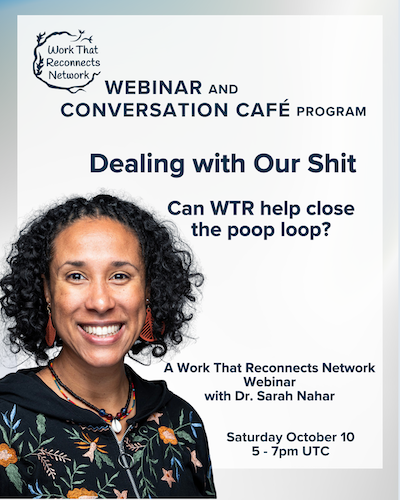
“Shit as System: Thinking with Joanna Macy” is Chapter 5 of the dissertation Fertile, Social, Dangerous, Sacred, Gift, and System: Religion, Salt City Harvest Farm, and the Future of Human Shit written by Dr. Sarah Nahar and completed in April of 2025.
Abstract
Shit, the taboo term for the human excreta that exits the anus, can be understood as sacred. Shitting, the vulgar verb to describe the act of discarding solid excreta, can likewise be understood as religious ritual activity. This counters the Dominant Social Paradigm’s (DSP) in the United States (US) of the placement of shit as profane, and shitting as unceremonial. This dissertation aims to reclaim the word shit from the realm of what the DSP has rendered invisible and unspeakable, and spark rigorous academic discussion about it in the context of Religion and Environmental Studies in the US.
The DSP is the set of widely held values, practices, and frameworks that shape a society’s worldview and influence its institutions. In the current US, the genealogy of the DSP comes from the Doctrine of Christian Discovery (DoCD), manifesting as the societal hegemony of cisheteronormative white Christian supremacist patriarchy. Never uncontested, but never defeated, this DSP views humans as superior to all other species, seeks to enlarge and protect an extraction-powered economy, sees progress as inherent in human history, and relies on technological solutions to address chronic and acute environmental and social problems.
In addition to analyzing three deceased scholars whose scholarship is foundational to the academic study of Religion, This dissertation features key offerings of leading scholar-activists living in this era, Robin Wall Kimmerer and Joanna Macy. Kimmerer’s writing on the gift economy and grammar of animacy, and Macy’s on general systems theory and the Work That Reconnects are theorized in light of shit and shitting. The result is an examination of the gift of shit, and the systemic nature of shit.
But first, this dissertation uses the phenomena of shit to examine definitions of the sacred and religious activity in the work of Émile Durkheim, Mary Douglas, and Rudolf Otto. In their theories, a focus on shit exposes gaps or ambiguities in the categories they created. As an essential aspect of human life as material beings, why have shit and shitting been so disregarded in the central literature of Religion? The shit we produce has implications for both us as individuals and for our collective life on planet earth, especially in a time of increasing climate chaos. From awe to disgust to neutrality to quiet curiosity, apprehension of its production and presence is evocative but inexact.
Why the silence and intricate social conventions that render shit as inaudible and invisible as possible? In areas where freshwater flush toilets are the main excreta infrastructure technology (ExIT), why is there so much resistance to ExIT system transformation, even as water-based sanitation is known to be financially costly as well as to toxify rivers and lakes? Why is addressing the worldwide sanitation crisis one of the most underfunded global initiatives? How is the treatment of shit, labeled a disposable material, replicated in the treatment of people, when they are labeled disposable? As in, who is being treated like shit by this society? What is happening to them? What possibilities of literal and metaphorical (re)integration are there, for materials and populations designated expendable? How does the word shit function linguistically in US American English, and what’s at stake in its use?
This literature review is enriched by an ethnography of Salt City Harvest Farm (SCHF), an organization serving refugee farmers in upstate New York (unceded Onondaga land), who are in the process of making a collective decision regarding which excreta infrastructure technology (ExIT) system is ideal to construct at their farm site, in the future. The farm currently has one port-a-potty, which is not a sustainable solution. In anticipation of building a more permanent structure, they are going through a process of discerning between a wide range of ExIT options. These include decisions about the toilet interface (pedestal style or squat style), cleaning materials for the intergluteal cleft (toilet paper and/or water cleanse) as well as collection, processing, and disposal options (water-based or compost-based). This dissertation accompanied the first part of SCHF’s process, which involved participant observation, individual interviews, and facilitated group-discussion.
The choice of ethnographic field study was intentional as refugee farmers are treated like shit by US society, partially because they are ambiguous in citizenship, legal status, racialization, and cultural de/assimilation practices, and cannot be neatly categorized. This parallels shit’s ambiguity. In being both alive and dead, fertilizer and poison, attractive and repulsive, shit also cannot be neatly categorized. This causes great discomfort in the DSP which has come to prominence in its ability to enforce its categorizations and classifications, not in the least upon places perceived as “shithole countries,” from whence refugees come. In examining marginal material, from the context on the margins, by a scholar from and associated with historically marginalized communities, this dissertation makes a unique contribution to the emergent interdisciplinary field of discard studies (through Religion and Environmental Studies). Central to that field are the questions of who and what is discarded, and the systems of wasting and power therein. While only shit is extensively discussed throughout this text–urine, menstrual blood and other bodily excreta are sidelined as is any focus on shitting, the questions of integrative ways to discard as humans, and think about our discard as communities, are central.